Thursday, December 17, 2009

John Paul II to be Declared Venerable on Saturday?

If reports in the Italian press are correct, Pope Benedict XVI is to sign a decree on Saturday proclaiming John Paul II 'Venerable' - the penultimate stage to beatification.

Last month, the Vatican voted unanimously in favour of John Paul II having shown 'heroic' virtue'. Once the decree is signed, the Vatican and the Pope need to approve a miracle attributed to his intercession.

One often hears remarkable stories about John Paul II from colleagues in the Vatican press corps. Speaking to one journalist this week, he recounted to me how the late Pope fell and broke his arm when meeting a head of state in the apostolic palace. But instead of ending the meeting, he went on, shaking the hands of everyone despite being in obvious pain.

On a trip to India, all the papal party including the Pope came down with a bout of illness. They all slunk off to their sick beds, he said, but John Paul carried on despite being in obvious discomfort.

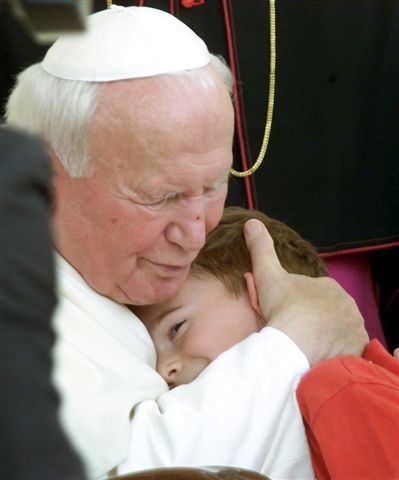
John Paul would also happily break with convention and go and greet people. He once sat down with a group of African children in his white cassock and got thoroughly dirty. "The Vatican protocol officials hated him for this!" said the journalist who had followed him for 15 years. "But he would do whatever he thought was right."

He also stressed that when John Paul II died, "he had nothing - absolutely no possessions." He had given everything away.

Wednesday, December 16, 2009

World Day of Peace Message 2010

Below are extracts of Pope Benedict XVI's Message for the World Day of Peace which takes place on January 1st. Its theme this year is “If You Want To Cultivate Peace, Protect Creation."

Man's inhumanity to man has given rise to numerous threats to peace and to authentic and integral human development - wars, international and regional conflicts, acts of terrorism, and violations of human rights. Yet no less troubling are the threats arising from the neglect - if not downright misuse - of the earth and the natural goods that God has given us. For this reason, it is imperative that mankind renew and strengthen "that covenant between human beings and the environment, which should mirror the creative love of God, from whom we come and towards whom we are journeying".

In 1990 John Paul II had spoken of an "ecological crisis" and ... pointed to the "urgent moral need for a new solidarity". His appeal is all the more pressing today, in the face of signs of a growing crisis which it would be irresponsible not to take seriously. Can we remain indifferent before the problems associated with such realities as climate change, desertification, the deterioration and loss of productivity in vast agricultural areas, the pollution of rivers and aquifers, the loss of biodiversity, the increase of natural catastrophes and the deforestation of equatorial and tropical regions? Can we disregard the growing phenomenon of "environmental refugees", people who are forced by the degradation of their natural habitat to forsake it - and often their possessions as well - in order to face the dangers and uncertainties of forced displacement? Can we remain impassive in the face of actual and potential conflicts involving access to natural resources? All these are issues with a profound impact on the exercise of human rights, such as the right to life, food, health and development.

The ecological crisis cannot be viewed in isolation from ... the notion of development itself and our understanding of man in his relationship to others and to the rest of creation. Prudence would thus dictate a profound, long-term review of our model of development, one which would take into consideration the meaning of the economy and its goals with an eye to correcting its malfunctions and misapplications. The ecological health of the planet calls for this, but it is also demanded by the cultural and moral crisis of humanity whose symptoms have for some time been evident in every part of the world.

Our present crises ... are ultimately also moral crises, and all of them are interrelated. They require us to rethink the path which we are travelling together. Specifically, they call for a lifestyle marked by sobriety and solidarity, with new rules and forms of engagement, one which focuses confidently and courageously on strategies that actually work, while decisively rejecting those that have failed. Only in this way can the current crisis become an opportunity for discernment and new strategic planning.

Environmental degradation is often due to the lack of far-sighted official policies or to the pursuit of myopic economic interests, which then, tragically, become a serious threat to creation. ... When making use of natural resources, we should be concerned for their protection and consider the cost entailed - environmentally and socially - as an essential part of the overall expenses incurred. The international community and national governments are responsible for sending the right signals in order to combat effectively the misuse of the environment. To protect the environment, and to safeguard natural resources and the climate, there is a need to act in accordance with clearly-defined rules, also from the juridical and economic standpoint, while at the same time taking into due account the solidarity we owe to those living in the poorer areas of our world and to future generations.

A greater sense of inter-generational solidarity is urgently needed. ... Natural resources should be used in such a way that immediate benefits do not have a negative impact on living creatures, human and not, present and future; that the protection of private property does not conflict with the universal destination of goods; that human activity does not compromise the fruitfulness of the earth, for the benefit of people now and in the future.

There is an urgent moral need for a renewed sense of intra-generational solidarity, especially in relationships between developing countries and highly-industrialised countries. ... The ecological crisis shows the urgency of a solidarity which embraces time and space. It is important to acknowledge that among the causes of the present ecological crisis is the historical responsibility of the industrialised countries. Yet the less-developed countries, and emerging countries in particular, are not exempt from their own responsibilities with regard to creation, for the duty of gradually adopting effective environmental measures and policies is incumbent upon all. This would be accomplished more easily if self-interest played a lesser role in the granting of aid and the sharing of knowledge and cleaner technologies.

To be sure, among the basic problems which the international community has to address is that of energy resources and the development of joint and sustainable strategies to satisfy the energy needs of the present and future generations. This means that technologically advanced societies must be prepared to encourage more sober lifestyles, while reducing their energy consumption and improving its efficiency. At the same time there is a need to encourage research into, and utilisation of, forms of energy with lower impact on the environment and "a worldwide redistribution of energy resources, so that countries lacking those resources can have access to them".

A sustainable comprehensive management of the environment and the resources of the planet demands that human intelligence be directed to technological and scientific research and its practical applications. The "new solidarity" for which John Paul II called ... and the "global solidarity" for which I myself appealed in my Message for the 2009 World Day of Peace are essential attitudes in shaping our efforts to protect creation through a better internationally-coordinated management of the earth's resources, particularly today, when there is an increasingly clear link between combating environmental degradation and promoting integral human development.

There is a need, in effect, to move beyond a purely consumerist mentality in order to promote forms of agricultural and industrial production capable of respecting creation and satisfying the primary needs of all. The ecological problem must be dealt with not only because of the chilling prospects of environmental degradation on the horizon; the real motivation must be the quest for authentic worldwide solidarity inspired by the values of charity, justice and the common good.

It is becoming more and more evident that the issue of environmental degradation challenges us to examine our lifestyle and the prevailing models of consumption and production, which are often unsustainable from a social, environmental and even economic point of view. ... We are all responsible for the protection and care of the environment. This responsibility knows no boundaries. In accordance with the principle of subsidiarity it is important for everyone to be committed at his or her proper level, working to overcome the prevalence of particular interests. A special role in raising awareness and in formation belongs to the different groups present in civil society and to the non-governmental organisations which work with determination and generosity for the spread of ecological responsibility, responsibility which should be ever more deeply anchored in respect for "human ecology".

The Church has a responsibility towards creation, and she considers it her duty to exercise that responsibility in public life, in order to protect earth, water and air as gifts of God the Creator meant for everyone, and above all to save mankind from the danger of self-destruction. ... Our duties towards the environment flow from our duties towards the person, considered both individually and in relation to others. Hence I readily encourage efforts to promote a greater sense of ecological responsibility which, as I indicated in my Encyclical "Caritas in Veritate", would safeguard an authentic "human ecology" and thus forcefully reaffirm the inviolability of human life at every stage and in every condition, the dignity of the person and the unique mission of the family, where one is trained in love of neighbour and respect for nature.

On the other hand, a correct understanding of the relationship between man and the environment will not end by absolutising nature or by considering it more important than the human person. If the Church's Magisterium expresses grave misgivings about notions of the environment inspired by eco-centrism and bio-centrism, it is because such notions eliminate the difference of identity and worth between the human person and other living things. In the name of a supposedly egalitarian vision of the "dignity" of all living creatures, such notions end up abolishing the distinctiveness and superior role of human beings. They also open the way to a new pantheism tinged with neo-paganism, which would see the source of man's salvation in nature alone, understood in purely naturalistic terms.

If you want to cultivate peace, protect creation. The quest for peace by people of good will surely would become easier if all acknowledge the indivisible relationship between God, human beings and the whole of creation. In the light of divine Revelation and in fidelity to the Church's Tradition, Christians have their own contribution to make. They contemplate the cosmos and its marvels in light of the creative work of the Father and the redemptive work of Christ, who by His death and resurrection has reconciled with God "all things, whether on earth or in heaven".

Monday, December 14, 2009

Pope's UK Visit Taking Shape

Preparations are continuing for Pope Benedict XVI’s visit to Britain in 2010, although an official announcement is not expected until well into the new year.

Last week, U.K. government officials were at the Vatican to discuss the Pope’s travel plans while their Vatican counterparts have been in Britain also making preparations.

A senior source at the Vatican told me that a four day visit looks likely in mid September next year with the beatification of Cardinal John Henry Newman being the “lynchpin” of the trip.

The Holy Father is expected to make at least two keynote addresses in England: one to politicians and diplomats which may take place in Westminster Hall, the place where St. Thomas More was condemned. The other will be to academics at the University of Oxford. He is also expected to make addresses to clergy and religious, and possibly meet ecumenical and interreligious leaders and young people.

He will then travel to Birmingham for Cardinal Newman’s beatification although it’s not yet clear if he will preside over the ceremony. Usually, beatifications are carried out by the prefect of the Congregation for the Causes of Saints but the Pope, a long admirer of the 19th century theologian, is reportedly expected to waive that rule and beatify him himself. After the ceremony, the Holy Father will then travel up to Scotland.

The senior official denied speculation that the visit will be downgraded from a state visit because of tensions with the Anglican Communion over the Apostolic Constitution for Anglicans. To know better how the Pope will be honoured, he advised looking at Benedict XVI’s visit to Paris last September.

Photo: Pope Benedict XVI meeting the Prime Minister of Montenegro today.

Friday, December 11, 2009

Vatican Statement on Irish Child Abuse Scandal

The Vatican has issued a much anticipated statement on the child abuse scandal in the Irish Church following publication of the Murphy Report on the Archdiocese of Dublin.

The communique reads:

"Today the Holy Father held a meeting with senior Irish Bishops and high-ranking members of the Roman Curia. He listened to their concerns and discussed with them the traumatic events that were presented in the Irish Commission of Investigation’s Report into the Catholic Archdiocese of Dublin.

After careful study of the Report, the Holy Father was deeply disturbed and distressed by its contents. He wishes once more to express his profound regret at the actions of some members of the clergy who have betrayed their solemn promises to God, as well as the trust placed in them by the victims and their families, and by society at large.

The Holy Father shares the outrage, betrayal and shame felt by so many of the faithful in Ireland, and he is united with them in prayer at this difficult time in the life of the Church.

His Holiness asks Catholics in Ireland and throughout the world to join him in praying for the victims, their families and all those affected by these heinous crimes.

He assures all concerned that the Church will continue to follow this grave matter with the closest attention in order to understand better how these shameful events came to pass and how best to develop effective and secure strategies to prevent any recurrence.

The Holy See takes very seriously the central issues raised by the Report, including questions concerning the governance of local Church leaders with ultimate responsibility for the pastoral care of children.

The Holy Father intends to address a Pastoral Letter to the faithful of Ireland in which he will clearly indicate the initiatives that are to be taken in response to the situation.

Finally, His Holiness encourages all those who have dedicated their lives in generous service to children to persevere in their good works in imitation of Christ the Good Shepherd."

The independent report was commissioned by the Irish government to investigate the way in which the Church dealt with allegations of sexual abuse of children by priests in Dublin over the period 1975 to 2004. It concluded that "the Dublin Archdiocese's pre-occupations in dealing with cases of child sexual abuse, at least until the mid 1990s, were the maintenance of secrecy, the avoidance of scandal, the protection of the reputation of the Church, and the preservation of its assets. All other considerations, including the welfare of children and justice for victims, were subordinated to these priorities. The Archdiocese did not implement its own canon law rules and did its best to avoid any application of the law of the State".

Obviously a dreadful story which has done immense damage to the Church. It also does no good to skate over this and pretend it never happened.

The Holy Father has handled this very well, taking his time to read the report before responding, and holding this 'summit meeting' at the Vatican. John Paul II did the same in 2002 soon after the US clerical abuse scandal broke.

Wednesday, December 9, 2009

Diplomatic Ties with Vietnam?

The Holy Father meets Vietnamese president Nguyen Minh Triet on Friday amid speculation that the communist country may agree to establish diplomatic relations with the Holy See.

In an interview this week with Corriere della Sera, the president expressed a wish to establish formal ties, saying that his country was "working to open diplomatic relations with the Vatican."

If such a development happens, it could give hope to Catholics in communist China who continue to suffer from tight restrictions on freedom of worship.

Earlier this year, the Pope expressed hope for a "healthy" relationship between the Church and Vietnam's communist government, which confiscated Church property after taking power from the French in 1945.

Benedict XVI has made it a priority of his pontificate to build diplomatic relations with those countries without established ties with the Holy See, most importantly, China, Vietnam and Saudi Arabia.

Vietnam's 6 million Roman Catholics are the second largest Catholic-community in Asia.

Photo: Nguyen Minh Triet

Benedict XVI and Pollution of the Media

"There is another pollution, less perceptible to the senses, but just as dangerous. It is the pollution of the spirit; it is that which renders our faces less smiling, more gloomy, which leads us not to greet one another, to not look at one another in the face. [...] Persons become bodies, and these bodies lose the soul, become things, objects without a face, to be exchanged and consumed."
- - - -
In today's media, "evil is recounted, repeated, amplified, accustoming us to the most horrible things, making us become insensitive and, in some way, intoxicating us, because the negative is not fully disposed of and accumulates day after day."


Pope Benedict XVI speaking on the Feast of the Immaculate Conception at the Spanish Steps - a beautiful address, relevant as always to our times.

His comments cannot but resonate with anyone working in the media. It's steady focus on bad news is more harmful than perhaps many people realise, but I can't see editors changing. "If it bleeds, it leads" is generally their rule of thumb and they take their lead, of course, from media consumers. The Pope's real focus, however, was on life in cities, and the Holy Father does go on to point out how the media draws attention to the poor, marginalised and exploited, even if it is "without pity or with false pity."

For a full reading of the address, see Asia News.

Tuesday, December 8, 2009

Ali Agca to be Released

Mehmet Ali Agca, the Turkish mercenary who tried to assassinate John Paul II in 1981, will soon be free and plans to publish his memoirs.

For more on this, see here.

Unfortunately, Agca is dismissed by many as unbalanced and unreliable and so his testimony is generally ignored. But amid the crazy pronouncements he's made, perhaps there are some glimpses of truth yet to be revealed.

Photo: Pope John Paul II speaks with Mehmet Ali Agca in Agca's prison cell in Rome on Dec. 27, 1983. (AP Photo/Arturo Mari)