
This morning, the Pope addressed Scotland's Bishops who are in Rome until tomorrow on their five-yearly ad limina visit to the Vatican.
I've put in bold those parts of his speech which struck me as the most interesting:
Dear Brother Bishops,
I extend a warm welcome to all of you on your ad Limina visit to Rome. I thank you for the kind words that Cardinal Keith Patrick O’Brien has addressed to me on your behalf, and I assure you of my constant prayers for you and for the faithful entrusted to your care. Your presence here expresses a reality that lies at the heart of every Catholic diocese – its relationship of communio with the See of Peter, and hence with the universal Church. Pastoral initiatives that take due account of this essential dimension bring authentic renewal: when the bonds of communion with the universal Church, and in particular with Rome, are accepted joyfully and lived fully, the people’s faith can grow freely and yield a harvest of good works.
It is a happy coincidence that the Year for Priests, which the whole Church is currently celebrating, marks the four hundredth anniversary of the priestly ordination of the great Scottish martyr Saint John Ogilvie. Rightly venerated as a faithful servant of the Gospel, he was truly outstanding in his dedication to a difficult and dangerous pastoral ministry, to the point of laying down his life. Hold him up as an example for your priests today. I am glad to know of the emphasis you place on continuing formation for your clergy, especially through the initiative "Priests for Scotland". The witness of priests who are genuinely committed to prayer and joyful in their ministry bears fruit not only in the spiritual lives of the faithful, but also in new vocations. Remember, though, that your commendable initiatives to promote vocations must be accompanied by sustained catechesis among the faithful about the true meaning of priesthood. Emphasize the indispensable role of the priest in the Church’s life, above all in providing the Eucharist by which the Church herself receives life. And encourage those entrusted with the formation of seminarians to do all they can to prepare a new generation of committed and zealous priests, well equipped humanly, academically and spiritually for the task of ministry in the twenty-first century.
Hand in hand with a proper appreciation of the priest’s role is a correct understanding of the specific vocation of the laity. Sometimes a tendency to confuse lay apostolate with lay ministry has led to an inward-looking concept of their ecclesial role. Yet the Second Vatican Council’s vision is that wherever the lay faithful live out their baptismal vocation – in the family, at home, at work – they are actively participating in the Church’s mission to sanctify the world. A renewed focus on lay apostolate will help to clarify the roles of clergy and laity and so give a strong impetus to the task of evangelizing society.
That task requires a readiness to grapple firmly with the challenges presented by the increasing tide of secularism in your country. Support for euthanasia strikes at the very heart of the Christian understanding of the dignity of human life. Recent developments in medical ethics and some of the practices advocated in the field of embryology give cause for great concern. If the Church’s teaching is compromised, even slightly, in one such area, then it becomes hard to defend the fullness of Catholic doctrine in an integral manner. Pastors of the Church, therefore, must continually call the faithful to complete fidelity to the Church’s Magisterium, while at the same time upholding and defending the Church’s right to live freely in society according to her beliefs.
The Church offers the world a positive and inspiring vision of human life, the beauty of marriage and the joy of parenthood. It is rooted in God’s infinite, transforming and ennobling love for all of us, which opens our eyes to recognize and love his image in our neighbour (cf. Deus Caritas Est, 10-11 et passim). Be sure to present this teaching in such a way that it is recognized for the message of hope that it is. All too often the Church’s doctrine is perceived as a series of prohibitions and retrograde positions, whereas the reality, as we know, is that it is creative and life-giving, and it is directed towards the fullest possible realization of the great potential for good and for happiness that God has implanted within every one of us.
The Church in your country, like many in Northern Europe, has suffered the tragedy of division. It is sobering to recall the great rupture with Scotland’s Catholic past that occurred four hundred and fifty years ago. I give thanks to God for the progress that has been made in healing the wounds that were the legacy of that period, especially the sectarianism that has continued to rear its head even in recent times. Through your participation in Action of Churches Together in Scotland, see that the work of rebuilding unity among the followers of Christ is carried forward with constancy and commitment. While resisting any pressure to dilute the Christian message, set your sights on the goal of full, visible unity, for nothing less can respond to the will of Christ.
You can be proud of the contribution made by Scotland’s Catholic schools in overcoming sectarianism and building good relations between communities. Faith schools are a powerful force for social cohesion, and when the occasion arises, you do well to underline this point. As you encourage Catholic teachers in their work, place special emphasis on the quality and depth of religious education, so as to prepare an articulate and well-informed Catholic laity, able and willing to carry out its mission "by engaging in temporal affairs and by ordering them according to the plan of God" (Christifideles Laici, 15). A strong Catholic presence in the media, local and national politics, the judiciary, the professions and the universities can only serve to enrich Scotland’s national life, as people of faith bear witness to the truth, especially when that truth is called into question.
Later this year, I shall have the joy of being present with you and the Catholics of Scotland on your native soil. As you prepare for the Apostolic Visit, encourage your people to pray that it will be a time of grace for the whole Catholic community. Take the opportunity to deepen their faith and to rekindle their commitment to bear witness to the Gospel. Like the monks from Iona who spread the Christian message throughout the length and breadth of Scotland, let them be beacons of faith and holiness for the Scottish people today.
With these thoughts, I commend your apostolic labours to the intercession of Our Lady, Saint Andrew, Saint Margaret and all the saints of Scotland. To all of you, and to your clergy, religious and lay faithful I cordially impart my Apostolic Blessing as a pledge of peace and joy in the Lord Jesus Christ.
Friday, February 5, 2010

Wednesday, February 3, 2010
Easyjet's Offer to the Pope
 Easyjet are offering to fly the Holy Father to Britain for free when he visits later this year.
 The low-cost carrier said he could choose any of its routes between Rome and the UK, "even throwing in free ‘speedy boarding’ to ensure he gets his preferred seat", according to cheapflights.co.uk.
The airline is obviously trying to capitalise on protests against the trip, especially those who are demanding that taxpayers not foot the bill for the visit.
Usually, the Pope flies by an Alitalia chartered plane to the country he is visiting (not Mistral Air as the article says), and returns on the national carrier, in this case British Airways.
I don't see that changing, though it's nice of Easyjet to offer, not least for us journalists who travel with him. Cost per head for a journalist on the papal plane is usually anywhere between €3,000-6,000. The expenses also include food and accommodation.
If Easyjet give us discounts, too, we'd jump at the chance, though I bet they hadn't thought of us.
Monday, February 1, 2010
Pope Confirms Trip to Britain
Pope Benedict XVI today confirmed for the first time that he will be visiting Britain this year in an address to the bishops of England and Wales, currently on their ad limina visit to Rome.
"On the occasion of my forthcoming Apostolic Visit to Great Britain, I shall be able to witness that faith for myself and, as Successor of Peter, to strengthen and confirm it," he said.
His speech in full.
Dear Brother Bishops,
I welcome all of you on your ad Limina visit to Rome, where you have come to venerate the tombs of the Apostles Peter and Paul. I thank you for the kind words that Archbishop Vincent Nichols has addressed to me on your behalf, and I offer you my warmest good wishes and prayers for yourselves and all the faithful of England and Wales entrusted to your pastoral care. Your visit to Rome strengthens the bonds of communion between the Catholic community in your country and the Apostolic See, a communion that sustained your people’s faith for centuries, and today provides fresh energies for renewal and evangelization. Even amid the pressures of a secular age, there are many signs of living faith and devotion among the Catholics of England and Wales. I am thinking, for example, of the enthusiasm generated by the visit of the relics of Saint Thérèse, the interest aroused by the prospect of Cardinal Newman’s beatification, and the eagerness of young people to take part in pilgrimages and World Youth Days. On the occasion of my forthcoming Apostolic Visit to Great Britain, I shall be able to witness that faith for myself and, as Successor of Peter, to strengthen and confirm it. During the months of preparation that lie ahead, be sure to encourage the Catholics of England and Wales in their devotion, and assure them that the Pope constantly remembers them in his prayers and holds them in his heart.
Your country is well known for its firm commitment to equality of opportunity for all members of society. Yet as you have rightly pointed out, the effect of some of the legislation designed to achieve this goal has been to impose unjust limitations on the freedom of religious communities to act in accordance with their beliefs. In some respects it actually violates the natural law upon which the equality of all human beings is grounded and by which it is guaranteed. I urge you as Pastors to ensure that the Church’s moral teaching be always presented in its entirety and convincingly defended. Fidelity to the Gospel in no way restricts the freedom of others – on the contrary, it serves their freedom by offering them the truth. Continue to insist upon your right to participate in national debate through respectful dialogue with other elements in society. In doing so, you are not only maintaining long-standing British traditions of freedom of expression and honest exchange of opinion, but you are actually giving voice to the convictions of many people who lack the means to express them: when so many of the population claim to be Christian, how could anyone dispute the Gospel’s right to be heard?
If the full saving message of Christ is to be presented effectively and convincingly to the world, the Catholic community in your country needs to speak with a united voice. This requires not only you, the Bishops, but also priests, teachers, catechists, writers – in short all who are engaged in the task of communicating the Gospel – to be attentive to the promptings of the Spirit, who guides the whole Church into the truth, gathers her into unity and inspires her with missionary zeal.
Make it your concern, then, to draw on the considerable gifts of the lay faithful in England and Wales and see that they are equipped to hand on the faith to new generations comprehensively, accurately, and with a keen awareness that in so doing they are playing their part in the Church’s mission. In a social milieu that encourages the expression of a variety of opinions on every question that arises, it is important to recognize dissent for what it is, and not to mistake it for a mature contribution to a balanced and wide-ranging debate. It is the truth revealed through Scripture and Tradition and articulated by the Church’s Magisterium that sets us free. Cardinal Newman realized this, and he left us an outstanding example of faithfulness to revealed truth by following that “kindly light” wherever it led him, even at considerable personal cost. Great writers and communicators of his stature and integrity are needed in the Church today, and it is my hope that devotion to him will inspire many to follow in his footsteps.
Much attention has rightly been given to Newman’s scholarship and to his extensive writings, but it is important to remember that he saw himself first and foremost as a priest. In this Annus Sacerdotalis, I urge you to hold up to your priests his example of dedication to prayer, pastoral sensitivity towards the needs of his flock, and passion for preaching the Gospel. You yourselves should set a similar example. Be close to your priests, and rekindle their sense of the enormous privilege and joy of standing among the people of God as alter Christus. In Newman’s words, “Christ’s priests have no priesthood but His … what they do, He does; when they baptize, He is baptizing; when they bless, He is blessing” (Parochial and Plain Sermons, VI 242). Indeed, since the priest plays an irreplaceable role in the life of the Church, spare no effort in encouraging priestly vocations and emphasizing to the faithful the true meaning and necessity of the priesthood. Encourage the lay faithful to express their appreciation of the priests who serve them, and to recognize the difficulties they sometimes face on account of their declining numbers and increasing pressures. The support and understanding of the faithful is particularly necessary when parishes have to be merged or Mass times adjusted. Help them to avoid any temptation to view the clergy as mere functionaries but rather to rejoice in the gift of priestly ministry, a gift that can never be taken for granted.
Ecumenical and inter-religious dialogue assume great importance in England and Wales, given the varied demographic profile of the population. As well as encouraging you in your important work in these areas, I would ask you to be generous in implementing the provisions of the Apostolic Constitution Anglicanorum Coetibus, so as to assist those groups of Anglicans who wish to enter into full communion with the Catholic Church. I am convinced that, if given a warm and open-hearted welcome, such groups will be a blessing for the entire Church.
With these thoughts, I commend your apostolic ministry to the intercession of Saint David, Saint George and all the saints and martyrs of England and Wales. May Our Lady of Walsingham guide and protect you always. To all of you, and to the priests, religious and lay faithful of your country, I cordially impart my Apostolic Blessing as a pledge of peace and joy in the Lord Jesus Christ.
From the Vatican, 1 February 2010
"On the occasion of my forthcoming Apostolic Visit to Great Britain, I shall be able to witness that faith for myself and, as Successor of Peter, to strengthen and confirm it," he said.
His speech in full.
Dear Brother Bishops,
I welcome all of you on your ad Limina visit to Rome, where you have come to venerate the tombs of the Apostles Peter and Paul. I thank you for the kind words that Archbishop Vincent Nichols has addressed to me on your behalf, and I offer you my warmest good wishes and prayers for yourselves and all the faithful of England and Wales entrusted to your pastoral care. Your visit to Rome strengthens the bonds of communion between the Catholic community in your country and the Apostolic See, a communion that sustained your people’s faith for centuries, and today provides fresh energies for renewal and evangelization. Even amid the pressures of a secular age, there are many signs of living faith and devotion among the Catholics of England and Wales. I am thinking, for example, of the enthusiasm generated by the visit of the relics of Saint Thérèse, the interest aroused by the prospect of Cardinal Newman’s beatification, and the eagerness of young people to take part in pilgrimages and World Youth Days. On the occasion of my forthcoming Apostolic Visit to Great Britain, I shall be able to witness that faith for myself and, as Successor of Peter, to strengthen and confirm it. During the months of preparation that lie ahead, be sure to encourage the Catholics of England and Wales in their devotion, and assure them that the Pope constantly remembers them in his prayers and holds them in his heart.
Your country is well known for its firm commitment to equality of opportunity for all members of society. Yet as you have rightly pointed out, the effect of some of the legislation designed to achieve this goal has been to impose unjust limitations on the freedom of religious communities to act in accordance with their beliefs. In some respects it actually violates the natural law upon which the equality of all human beings is grounded and by which it is guaranteed. I urge you as Pastors to ensure that the Church’s moral teaching be always presented in its entirety and convincingly defended. Fidelity to the Gospel in no way restricts the freedom of others – on the contrary, it serves their freedom by offering them the truth. Continue to insist upon your right to participate in national debate through respectful dialogue with other elements in society. In doing so, you are not only maintaining long-standing British traditions of freedom of expression and honest exchange of opinion, but you are actually giving voice to the convictions of many people who lack the means to express them: when so many of the population claim to be Christian, how could anyone dispute the Gospel’s right to be heard?
If the full saving message of Christ is to be presented effectively and convincingly to the world, the Catholic community in your country needs to speak with a united voice. This requires not only you, the Bishops, but also priests, teachers, catechists, writers – in short all who are engaged in the task of communicating the Gospel – to be attentive to the promptings of the Spirit, who guides the whole Church into the truth, gathers her into unity and inspires her with missionary zeal.
Make it your concern, then, to draw on the considerable gifts of the lay faithful in England and Wales and see that they are equipped to hand on the faith to new generations comprehensively, accurately, and with a keen awareness that in so doing they are playing their part in the Church’s mission. In a social milieu that encourages the expression of a variety of opinions on every question that arises, it is important to recognize dissent for what it is, and not to mistake it for a mature contribution to a balanced and wide-ranging debate. It is the truth revealed through Scripture and Tradition and articulated by the Church’s Magisterium that sets us free. Cardinal Newman realized this, and he left us an outstanding example of faithfulness to revealed truth by following that “kindly light” wherever it led him, even at considerable personal cost. Great writers and communicators of his stature and integrity are needed in the Church today, and it is my hope that devotion to him will inspire many to follow in his footsteps.
Much attention has rightly been given to Newman’s scholarship and to his extensive writings, but it is important to remember that he saw himself first and foremost as a priest. In this Annus Sacerdotalis, I urge you to hold up to your priests his example of dedication to prayer, pastoral sensitivity towards the needs of his flock, and passion for preaching the Gospel. You yourselves should set a similar example. Be close to your priests, and rekindle their sense of the enormous privilege and joy of standing among the people of God as alter Christus. In Newman’s words, “Christ’s priests have no priesthood but His … what they do, He does; when they baptize, He is baptizing; when they bless, He is blessing” (Parochial and Plain Sermons, VI 242). Indeed, since the priest plays an irreplaceable role in the life of the Church, spare no effort in encouraging priestly vocations and emphasizing to the faithful the true meaning and necessity of the priesthood. Encourage the lay faithful to express their appreciation of the priests who serve them, and to recognize the difficulties they sometimes face on account of their declining numbers and increasing pressures. The support and understanding of the faithful is particularly necessary when parishes have to be merged or Mass times adjusted. Help them to avoid any temptation to view the clergy as mere functionaries but rather to rejoice in the gift of priestly ministry, a gift that can never be taken for granted.
Ecumenical and inter-religious dialogue assume great importance in England and Wales, given the varied demographic profile of the population. As well as encouraging you in your important work in these areas, I would ask you to be generous in implementing the provisions of the Apostolic Constitution Anglicanorum Coetibus, so as to assist those groups of Anglicans who wish to enter into full communion with the Catholic Church. I am convinced that, if given a warm and open-hearted welcome, such groups will be a blessing for the entire Church.
With these thoughts, I commend your apostolic ministry to the intercession of Saint David, Saint George and all the saints and martyrs of England and Wales. May Our Lady of Walsingham guide and protect you always. To all of you, and to the priests, religious and lay faithful of your country, I cordially impart my Apostolic Blessing as a pledge of peace and joy in the Lord Jesus Christ.
From the Vatican, 1 February 2010
Saturday, January 23, 2010
John Paul II Beatification October 10?
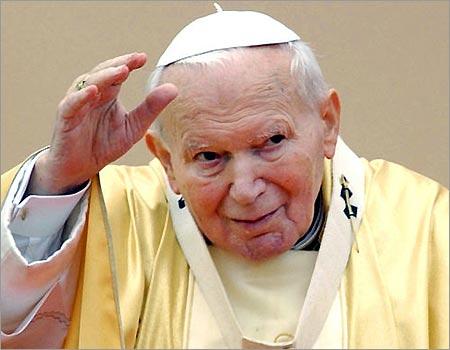 At least two Italian newspapers have today claimed that John Paul II will be beatified in October this year, although the date remains highly speculative.
Without naming sources, Il Sole 24 Ore and La Stampa are confidently predicting the ceremony will take place on October 10th in St. Peter’s Square.
Read more...
Friday, January 22, 2010
Benedict XVI's Book Finished; Published Probably in Spring
 The Holy Father will soon be publishing his second volume of 'Jesus of Nazareth'. Quite a feat considering his normal heavy workload and having been prevented from writing over the summer when he broke his wrist.
My latest article for Newsmax:
Pope Benedict XVI has completed his second book on Jesus, according to an American rabbi who is a close friend of the Pope.
Once published, the book will mark the Pope's most recent attempt to try to help people encounter Jesus in their everyday lives and enter into a relationship with him.
Rabbi Jacob Neusner, a professor at Bard College in Annandale-on-Hudson, N.Y., told the Vatican newspaper L'Osservatore Romano that the Pope informed him of the book's completion during a 20-minute meeting at the Vatican on Monday.
Neusner, a prolific and highly respected author of books on Judaism and Jewish interreligious relations, said the two "talked about our books, and he told me he had finished writing the second volume on Jesus."
The first volume of "Jesus of Nazareth," published in 2007, covered Jesus' life from his baptism in the River Jordan to his transfiguration. This second volume is expected to feature Benedict's reflections on the mysteries of Jesus’ passion, death, and resurrection, and include a chapter on the nativity.
In the foreword to the previous volume, Benedict gave reasons for writing the book, saying he had long been concerned about a general trend among scholars to separate the "historical Jesus" and the "Christ of faith."
The aim of these works, he said, is therefore to salvage the person of Jesus from recent "popular" depictions and to restore Jesus' true identity with the overall goal of helping people "to foster the growth of a living relationship" with Jesus Christ. The series, he wrote, had had "long gestation," going back to 2003 when he was still a cardinal.
In September, Benedict said he was able to make "a little bit of progress with the book" during the summer holidays, despite breaking his wrist in a fall while vacationing in the Italian Alps.
"I still have much to do," he said. "I think that, with the bibliography and everything that is still to be done, 'Deo adjuvante,' it could be finished next spring. But this is a hope!"
The fact that he revealed the news to a rabbi first is significant and may, in a minor way, help calm recent Catholic-Jewish tensions. But Rabbi Neusner's involvement in the announcement is not as surprising as it might seem. His 1993 book, "A Rabbi Talks With Jesus," figured highly in the first volume of "Jesus of Nazareth," and the two have known each other many years. Neusner has since been nicknamed "The Pope's Favorite Rabbi."
In "A Rabbi Talks With Jesus," Neusner imagines himself among the crowds when Jesus gives his Sermon on the Mount, hearing the Beatitudes for the first time. Neusner's challenge is to listen to Jesus but without all the misunderstandings and prejudices that inevitably have accumulated in the 2,000 years of Christianity's history. He admires Jesus' greatness but in the end decides not to follow him, remaining, as he puts it, "with the eternal Israel."
The Pope included the work to show how the rabbi's dialogue with Jesus "highlights the differences in all their sharpness, but it also takes place in great love." The rabbi, he added, "accepts the otherness of Jesus' message, and takes leave free of any rancor; this parting, accomplished in the rigor of truth, is ever mindful of the reconciling power of love."
As has been shown in recent weeks, Benedict XVI sees this as the path of true dialogue between Jews and Christians: not to hide their respective claims to truth but to shed light on them in reciprocal understanding and respect.
Neusner said that, during his recent meeting with Benedict he was struck by the Pope's "gentlemanly ways, full of kindness and humility."
These characteristics were on show when the Pope made his historic visit to Rome's synagogue on Sunday, Neusner said, adding, "It was a great event: The participation was enormous, everyone was tense and agitated, it gave me hope for the future."
It's not clear how much Neusner's works will figure in the new volume, nor exactly when it will be published. However, Benedict XVI's prediction of sometime in the spring probably still stands.
Tuesday, January 12, 2010
The Pope's Year in 2010

A look ahead to the Pope's busy year this year.
Particularly interesting in light of recent tensions will be his visit to Rome's synagogue on Sunday. What's often forgotten is that much of the Church's policy towards the Jews under John Paul II - a time of great rapprochement - was directed by Cardinal Joseph Ratzinger. With that in mind, he will undoubtedly find the right words to say on Sunday, although expect some Jewish leaders to remain implacable.
Monday, January 11, 2010
Pope's Attacker Freed
The Vatican has freed Susanna Maiolo, the 25 year old Swiss woman who knocked over the Pope on Christmas Eve.
A Holy See spokesman told me she's been allowed to return to Switzerland but had no further details.
However, a Vatican judge still has to pronounce a verdict on the case.
A Holy See spokesman told me she's been allowed to return to Switzerland but had no further details.
However, a Vatican judge still has to pronounce a verdict on the case.
Subscribe to:
Posts (Atom)
