Saturday, January 23, 2010

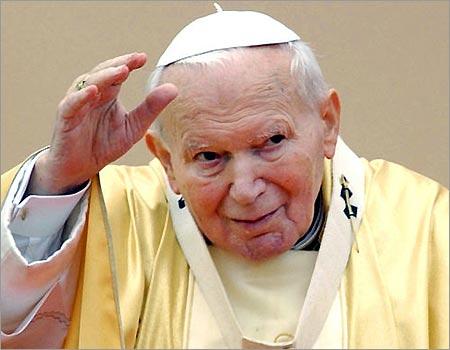
John Paul II Beatification October 10?

At least two Italian newspapers have today claimed that John Paul II will be beatified in October this year, although the date remains highly speculative.

Without naming sources, Il Sole 24 Ore and La Stampa are confidently predicting the ceremony will take place on October 10th in St. Peter’s Square.

Read more...

Friday, January 22, 2010

Benedict XVI's Book Finished; Published Probably in Spring

The Holy Father will soon be publishing his second volume of 'Jesus of Nazareth'. Quite a feat considering his normal heavy workload and having been prevented from writing over the summer when he broke his wrist.

My latest article for Newsmax:

Pope Benedict XVI has completed his second book on Jesus, according to an American rabbi who is a close friend of the Pope.

Once published, the book will mark the Pope's most recent attempt to try to help people encounter Jesus in their everyday lives and enter into a relationship with him.

Rabbi Jacob Neusner, a professor at Bard College in Annandale-on-Hudson, N.Y., told the Vatican newspaper L'Osservatore Romano that the Pope informed him of the book's completion during a 20-minute meeting at the Vatican on Monday.

Neusner, a prolific and highly respected author of books on Judaism and Jewish interreligious relations, said the two "talked about our books, and he told me he had finished writing the second volume on Jesus."

The first volume of "Jesus of Nazareth," published in 2007, covered Jesus' life from his baptism in the River Jordan to his transfiguration. This second volume is expected to feature Benedict's reflections on the mysteries of Jesus’ passion, death, and resurrection, and include a chapter on the nativity.

In the foreword to the previous volume, Benedict gave reasons for writing the book, saying he had long been concerned about a general trend among scholars to separate the "historical Jesus" and the "Christ of faith."

The aim of these works, he said, is therefore to salvage the person of Jesus from recent "popular" depictions and to restore Jesus' true identity with the overall goal of helping people "to foster the growth of a living relationship" with Jesus Christ. The series, he wrote, had had "long gestation," going back to 2003 when he was still a cardinal.

In September, Benedict said he was able to make "a little bit of progress with the book" during the summer holidays, despite breaking his wrist in a fall while vacationing in the Italian Alps.

"I still have much to do," he said. "I think that, with the bibliography and everything that is still to be done, 'Deo adjuvante,' it could be finished next spring. But this is a hope!"

The fact that he revealed the news to a rabbi first is significant and may, in a minor way, help calm recent Catholic-Jewish tensions. But Rabbi Neusner's involvement in the announcement is not as surprising as it might seem. His 1993 book, "A Rabbi Talks With Jesus," figured highly in the first volume of "Jesus of Nazareth," and the two have known each other many years. Neusner has since been nicknamed "The Pope's Favorite Rabbi."

In "A Rabbi Talks With Jesus," Neusner imagines himself among the crowds when Jesus gives his Sermon on the Mount, hearing the Beatitudes for the first time. Neusner's challenge is to listen to Jesus but without all the misunderstandings and prejudices that inevitably have accumulated in the 2,000 years of Christianity's history. He admires Jesus' greatness but in the end decides not to follow him, remaining, as he puts it, "with the eternal Israel."

The Pope included the work to show how the rabbi's dialogue with Jesus "highlights the differences in all their sharpness, but it also takes place in great love." The rabbi, he added, "accepts the otherness of Jesus' message, and takes leave free of any rancor; this parting, accomplished in the rigor of truth, is ever mindful of the reconciling power of love."

As has been shown in recent weeks, Benedict XVI sees this as the path of true dialogue between Jews and Christians: not to hide their respective claims to truth but to shed light on them in reciprocal understanding and respect.

Neusner said that, during his recent meeting with Benedict he was struck by the Pope's "gentlemanly ways, full of kindness and humility."

These characteristics were on show when the Pope made his historic visit to Rome's synagogue on Sunday, Neusner said, adding, "It was a great event: The participation was enormous, everyone was tense and agitated, it gave me hope for the future."

It's not clear how much Neusner's works will figure in the new volume, nor exactly when it will be published. However, Benedict XVI's prediction of sometime in the spring probably still stands.

Tuesday, January 12, 2010

The Pope's Year in 2010


A look ahead to the Pope's busy year this year.

Particularly interesting in light of recent tensions will be his visit to Rome's synagogue on Sunday. What's often forgotten is that much of the Church's policy towards the Jews under John Paul II - a time of great rapprochement - was directed by Cardinal Joseph Ratzinger. With that in mind, he will undoubtedly find the right words to say on Sunday, although expect some Jewish leaders to remain implacable.

Monday, January 11, 2010

Pope's Attacker Freed

The Vatican has freed Susanna Maiolo, the 25 year old Swiss woman who knocked over the Pope on Christmas Eve.

A Holy See spokesman told me she's been allowed to return to Switzerland but had no further details.

However, a Vatican judge still has to pronounce a verdict on the case.

Friday, December 18, 2009

Looking Back at Pope Benedict XVI's Year


Overall, the Holy Father will probably look upon the year that's passing as a successful one, despite the odd frustration and slip up. But this Pope is not afraid to make mistakes and is well aware of his imperfections.

Professor Vincent Twomey, a former student of Joseph Ratzinger, wrote in his book: Pope Benedict XVI - The Conscience of Our Age:

"...this is one of the keys to Ratzinger's character (and also to his theology; in particular his theology of politics): his acceptance that everything we do is imperfect, that all knowledge is limited, no matter how brilliant or well read one may be...Ratzinger knows in his heart and soul that God alone is perfect and that all human attempts at perfection (such as political utopias) end in disaster."

My round up of his year can be found here.

Discussing Faith in Britain with Roger Scruton

Zenit has published my interview with the English philosopher Roger Scruton. I reproduce it below.

Scruton is sadly a rarity in my homeland: an academic who is a committed Christian and a conservative - atrributes which led to him being marginalized as a professor. But he hasn't been a university lecturer for 20 years and says he prefers writing and speaking. He says his views are more widely heard now than they were as an academic.

The Loss of Beauty

...One of the conference speakers was the renowned Anglo-American philosopher, writer and composer, Roger Scruton. After his address, I sat down with him to talk about his speech and the state of religion in the West, particularly in Britain.

The essence of Scruton's talk was how, until relatively recently, artistic creation of beauty was about giving glory to God, but now is often about desecrating the human form. He explored the reasons why.

"Artists in the post enlightenment period tried hard to hold on to the idea of beauty precisely to compensate for the loss of their faith," he explains. Musicians such as Wagner, he adds, saw it as "the unique vestige of the sacred in our world," and modernism tried to reconnect with the sacred through art created by writers and musicians such as Eliot, Messiaen, and Brittan.

"Then suddenly in our time, since the 1960s and all the rest, we have a new kind of art which is repudiating beauty and putting ugliness in its place," Scruton explains. "I'd say it's an 'art of desecration' which looks not to desecrate beauty, but to desecrate the human form."

He refers to "the examples of the usual young British art types" such as Damian Hirst, and in particular the conceptual artists Jake and Dinos Chapman, two brothers whose work Scruton describes as "particularly repulsive."

"So I asked myself: What does this mean? Why should people want to desecrate the human form and the ordinary ideals of human life? And I say, you only desecrate what is sacred. Only something sacred can be desecrated. So there's this cry from the heart here for the religious meaning of things. It's showing the yearning for God and the sense that these things make no sense without him."

He adds that we have "lost all that idea that beauty is something we create together by way of embellishing our world."

In the past, Scruton has pointed to the difficulties of proving "the truth of religious sentiments." He is well aware of the challenges, having debated the well-known atheists Richard Dawkins and Christopher Hitchens in the past. So how can Christians find a better way of communicating the truth of the faith in the world today?

"Intelligent people don't see a problem in seeing that there can be truths which lie beyond the reach of scientific argument and there can be truths whose content was only revealed through a way of living – that's the task of theology and philosophy, to make that clear," he says. "But ordinary people don't see religion in that way. For them it's a matter of basic certainties. Certainties are very hard to rediscover once they've been lost."

I ask how the faith could be brought back to Britain which appears to be in desperate need of a return to its Christian roots. Just this week a survey revealed that only half of Britons now consider themselves Christian after a "sharp decline" in religious belief over the past quarter of a century. "To re-evangelize the English, you'd need a new Augustine [of Canterbury]," Scruton replies. But he warns that if the Christian faith has vanished completely from Britain, then that leaves a vacuum into which another faith will flow.

"The Christian faith might flow back but then it's in competition with all the other things that might flow in: the New Age type religions, Hinduism, and Buddhism. There may be a complete fragmentation as under the late Roman Empire: before Christianity took over, there were thousands of little cults. But, of course, Islam will then have a big following because it will be the only thing that establishes a unity."

I put it to him that perhaps the Pope's expected visit to Britain next year, the beatification of Cardinal John Henry Newman and the new provisions for disaffected Anglicans point to some urgency toward the re-evangelization of the country. "Yes, that might be a possibility," he says, adding that a general election is also expected in 2010. "Maybe we'll see a wholesale conversion of the English to their faith."

We then turned to today's prominent atheists and the best way to debate them. "You've got to have the right people up against them," he says. "You need people who are stronger and wittier than they are in an argument. You have to get the right audience as well."

He says he doesn't mind debating people like Dawkins and Hitchens. "The problem is what I have to say doesn't directly confront what they have to say," he says. "There's nothing in what Dawkins says that I can actually disagree with -- it's just that it leaves out half of life. He talks perfectly reasonably about the explanation of human life, but not about its meaning."

Although an Anglican, the philosopher is particularly sympathetic to Benedict XVI's stand against what Scruton calls the vandalism of the liturgy and the musical traditions of the Church. "That resonates with me," he says. "I've felt it was so unnecessary giving way to temporary fashions which have now disappeared. But now the Church has to work to rediscover what it could have had without working for it."

Thursday, December 17, 2009

John Paul II to be Declared Venerable on Saturday?

If reports in the Italian press are correct, Pope Benedict XVI is to sign a decree on Saturday proclaiming John Paul II 'Venerable' - the penultimate stage to beatification.

Last month, the Vatican voted unanimously in favour of John Paul II having shown 'heroic' virtue'. Once the decree is signed, the Vatican and the Pope need to approve a miracle attributed to his intercession.

One often hears remarkable stories about John Paul II from colleagues in the Vatican press corps. Speaking to one journalist this week, he recounted to me how the late Pope fell and broke his arm when meeting a head of state in the apostolic palace. But instead of ending the meeting, he went on, shaking the hands of everyone despite being in obvious pain.

On a trip to India, all the papal party including the Pope came down with a bout of illness. They all slunk off to their sick beds, he said, but John Paul carried on despite being in obvious discomfort.

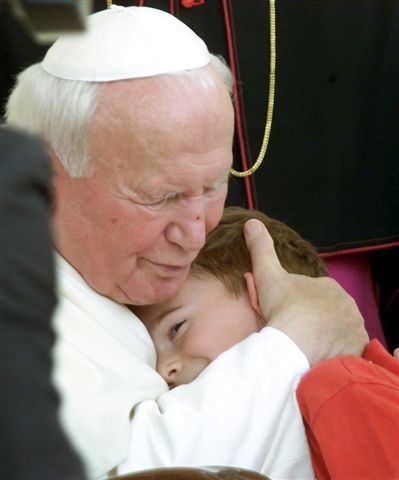
John Paul would also happily break with convention and go and greet people. He once sat down with a group of African children in his white cassock and got thoroughly dirty. "The Vatican protocol officials hated him for this!" said the journalist who had followed him for 15 years. "But he would do whatever he thought was right."

He also stressed that when John Paul II died, "he had nothing - absolutely no possessions." He had given everything away.